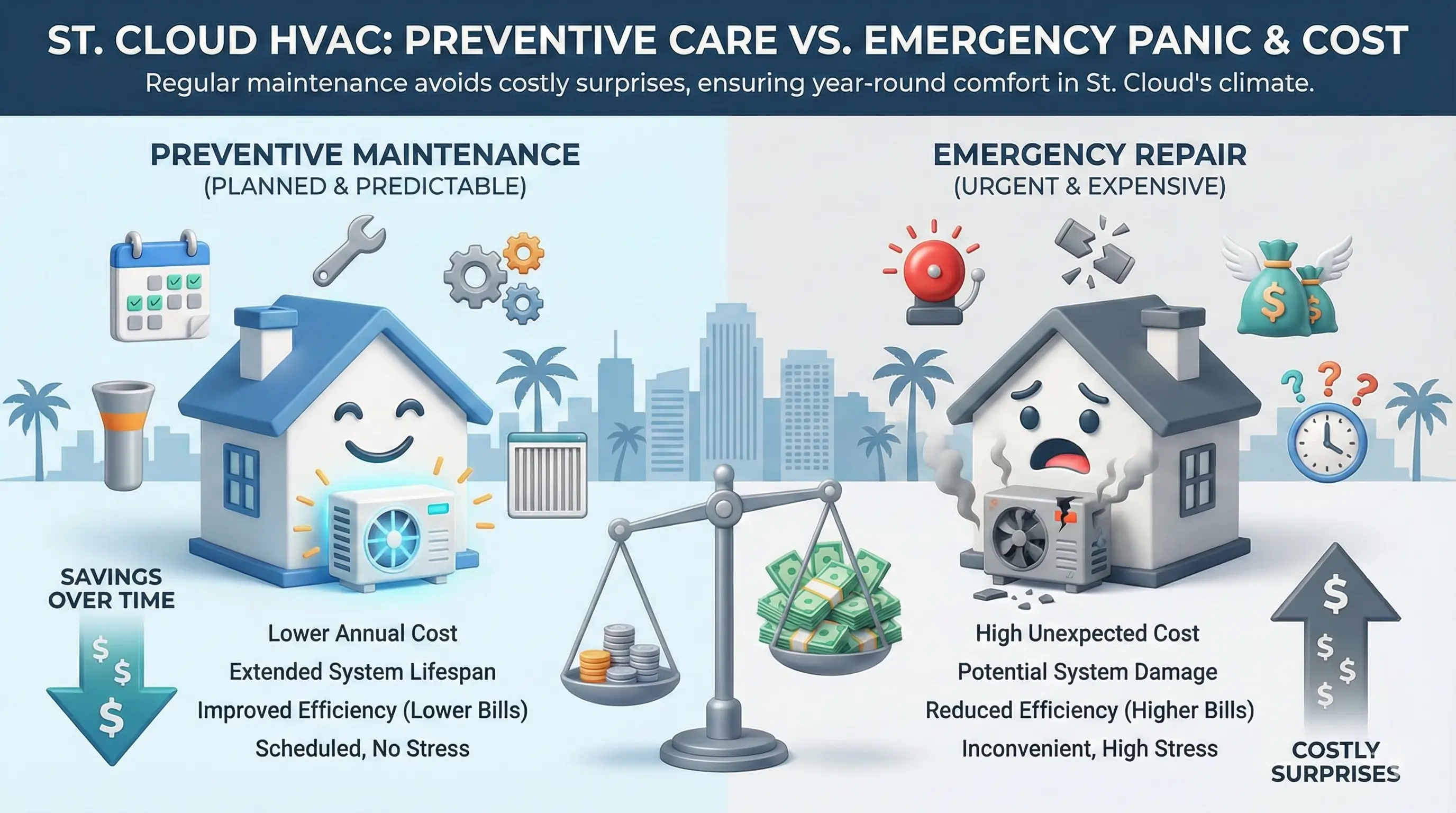
After servicing hundreds of St. Cloud HVAC systems over the years, I've noticed a pattern: homeowners who skip their spring maintenance call us in July when their AC fails—and they're facing bills that average $1,200 to $1,800 instead of the $150-$200 they would have spent on prevention.
Living and working in Central Florida myself, I know exactly what St. Cloud's subtropical climate does to HVAC systems. The combination of high humidity, afternoon thunderstorms, and near-constant AC use from March through October puts unique stress on your equipment that's different from what systems face in drier parts of the state. From what I've seen in local homes, this aggressive climate accelerates wear on specific components—particularly condensate drains, coils, and capacitors—that fail predictably when neglected.
Here's what most St. Cloud homeowners don't realize: emergency repairs cost 3-5 times more than preventive maintenance, but the real expense isn't just the service call. It's the expedited parts markup, after-hours rates, and the reality that available technicians during peak season might be days away while your family swelters indoors.
This guide shares actual cost breakdowns from St. Cloud service calls, explains which maintenance tasks prevent the most expensive failures in our climate, and shows you how to s statistic.
TL;DR Quick Answers
HVAC Repair in St. Cloud
Cost Range: $300-$2,500 depending on what failed. Capacitors run $300-$500, blower motors $450-$750, coils $1,000-$1,800, compressors $1,200-$2,500. Add $125-$175 for emergency service calls.
Response Time: 2-3 days during peak summer season (June-September) for standard service. Same-day emergency service available at premium rates.
Most Common Issues in St. Cloud:
Capacitor failures from heat stress
Clogged condensate drains from humidity and algae
Dirty coils from pollen buildup
Refrigerant leaks from corrosion
Repair vs Replace: Multiply system age by repair cost. If it exceeds $5,000, replace the system. Consider maintenance history—well-maintained systems are worth repairing.
Preventive Maintenance: $150-$200 per visit, twice yearly. Prevents 95% of breakdowns and costs far less than emergency repairs.
Permit Requirements: Routine repairs don't need permits. Refrigerant work, ductwork changes, electrical connections, and replacements require Osceola County permits.
Best Practice: Schedule spring maintenance before cooling season starts in March to avoid summer emergency situations when every technician is booked solid.
Top Takeaways
Emergency repairs cost 3-5 times more than preventive maintenance.
Annual maintenance: $300-$400
Common emergency repairs: $1,200-$1,800
Major component failures: $2,000-$2,500+
St. Cloud's subtropical climate accelerates HVAC wear.
Your system runs 3,000+ hours annually
That's double what northern systems experience
Constant heat and humidity mean faster component failure without maintenance
95% of system breakdowns are preventable.
Department of Energy research confirms this
My service records show the same pattern
Almost every emergency call fixes problems maintenance would have caught early
Skipping maintenance costs you money every single month.
Neglected systems use 25-30% more electricity
Extra cost: $75-$90 monthly on summer bills
Annual waste: $900+ that maintenance prevents
Maintenance extends your system's life by 7-8 years.
Maintained systems: 15-20 years in our climate
Neglected systems: 10-12 years
Skipping $2,800 in maintenance costs you a $6,000-$8,000 premature replacement
Net loss: $3,200-$5,200
Routine HVAC maintenance in St. Cloud runs between $150 and $200 per visit. Most systems need two visits yearly—one before cooling season starts in March and another before the occasional winter heating needs kick in around November.
That $300-$400 annual investment covers a comprehensive system inspection, refrigerant level check, coil cleaning, condensate drain clearing, electrical connection tightening, and filter replacement. From my experience servicing St. Cloud homes, that condensate drain clearing alone prevents about 40% of the emergency calls we receive during summer months. Florida's humidity loads those drains with algae and buildup faster than systems in drier climates.
The technician also spots worn components before they fail—things like capacitors showing early stress signs, contactors with pitting, or refrigerant levels dropping slightly due to small leaks. Catching these during routine service means replacing a $30 capacitor on your schedule rather than paying $400 for emergency replacement when it fails on a Sunday afternoon.
The Real Cost of Emergency HVAC Repairs
Emergency service calls in St. Cloud start at $125-$175 just to get a technician to your door, and that's before any actual repair work begins. After-hours calls (evenings, weekends, holidays) add another $50-$100 to that trip charge.
I've seen common emergency repairs break down like this in St. Cloud:
Compressor failure runs $1,200 to $2,500 for parts and labor. Evaporator coil replacement costs $1,000 to $1,800. Blower motor replacement hits $450 to $750. Even "simple" repairs like capacitor or contactor replacement cost $300 to $500 in emergency situations versus $150-$200 during regular service.
The biggest expense isn't always the part itself. When your AC fails during St. Cloud's peak summer season, available technicians might be booked two or three days out. You're either paying premium emergency rates to jump the queue or sweating it out while your family, pets, and home suffer in 85-degree indoor temperatures.
Why St. Cloud's Climate Makes This Comparison Worse
St. Cloud sits in Central Florida's subtropical zone where AC systems run nearly year-round. I've worked on systems here that log 3,000+ runtime hours annually compared to 1,500-2,000 hours in northern states.
That constant operation combined with humidity levels regularly hitting 70-80% creates conditions where components simply wear out faster. Condensate pans overflow. Coils corrode. Electrical connections loosen from thermal expansion and contraction. Refrigerant leaks develop at connection points.
The afternoon thunderstorms common from June through September introduce another variable. Power fluctuations and lightning-induced surges stress electrical components in ways that don't show up immediately but lead to failures weeks or months later. A maintenance visit after storm season catches these issues before they cascade into full system breakdowns.
What Actually Fails Without Regular Maintenance
In St. Cloud systems that skip maintenance, I see the same component failures repeatedly. Capacitors typically last 5-7 years with maintenance but fail in 3-4 years without it. They're the most common emergency repair I handle locally.
Clogged condensate drains rank second. When that drain line backs up, the overflow switch shuts your system down. You're without cooling until someone clears the blockage—a 10-minute task during maintenance that becomes a $300+ emergency call when it happens at 6 PM on Friday.
Dirty coils reduce efficiency first, then cause compressor strain that leads to the single most expensive repair possible. I've diagnosed compressor failures on 8-10 year old systems that should have lasted 15 years. The common thread? Skipped maintenance meant dirty coils went unnoticed, the compressor worked harder to compensate, and premature failure resulted.
Low refrigerant from small leaks creates similar problems. During maintenance, we catch a system running half a pound low, find the leak, repair it, and top off the refrigerant for $200-$400 total. Skip maintenance, and that small leak becomes a completely empty system with a burned-out compressor from running without proper refrigerant flow—a $2,000+ repair.
The Hidden Costs Nobody Mentions
Emergency repairs carry expenses beyond the service bill. A system failure during St. Cloud's summer means potential damage to your home. Humidity levels spike without AC running, creating conditions for mold growth in as little as 24-48 hours. I've seen homeowners face mold remediation costs of $1,500-$3,000 after an extended AC outage.
Food spoilage adds up when indoor temperatures climb. Medications requiring cool storage become unsafe. If you have elderly family members or health conditions affected by heat, you're potentially booking hotel rooms at $150+ per night while waiting for repairs.
Your energy bills reflect poor maintenance too. A neglected system running with dirty coils and low refrigerant might use 25-30% more electricity while providing less cooling. On a typical St. Cloud summer electric bill of $250-$300, that's an extra $60-$90 monthly—costs that disappear with proper maintenance.
Making the Smart Choice for Your St. Cloud Home
The math is straightforward. Spending $300-$400 annually on preventive maintenance protects you from repair bills that average $800-$1,500 for common failures and can reach $2,500+ for major component replacement.
More importantly, you're avoiding the stress and disruption of emergency breakdowns during the times you need your AC most. Your system runs more efficiently, lowering monthly operating costs. Components last longer, delaying the eventual need for full system replacement.
After years of emergency calls to sweltering St. Cloud homes, I can tell you the pattern holds: homeowners who maintain their systems spend less on HVAC over the long term and deal with far fewer emergency situations. The ones who skip maintenance? I know them by name because I'm back at their homes repeatedly fixing preventable problems at premium rates.
"I've been servicing HVAC systems in St. Cloud for over two decades, and I can predict almost to the week when the emergency calls will flood in—it's always mid-July when we hit that stretch of 95-degree days with no afternoon storms to break the heat. The homeowners calling me aren't the ones I saw in March for their spring tune-up. They're the folks who skipped maintenance, and now their capacitor just failed or their coils are so caked with pollen and dirt that the system froze up. What frustrates me is seeing an 8-year-old system with a burned-out compressor that should've lasted another seven years. When I pull the panel and see coils that haven't been cleaned in years, I know exactly what happened—that compressor worked itself to death trying to cool through all that buildup. That's a $2,200 repair that a $180 maintenance visit would have prevented. Here in Central Florida, our humidity and runtime hours don't give systems any grace period. You either maintain them, or you pay me emergency rates to replace components that failed years before they should have."
7 Critical Resources Every St. Cloud Homeowner Needs Before Hiring an HVAC Contractor
1. Verify Your Contractor's Credentials Before They Touch Your System
Florida Department of Business and Professional Regulation https://www.myfloridalicense.com/intentions2.asp
I always tell St. Cloud homeowners to check this database before hiring anyone. You'll see the contractor's active license status, any disciplinary actions, and whether they're actually qualified to work on your system—because I've seen too many unlicensed "technicians" cause expensive damage that licensed contractors then have to fix.
2. Understand How Indoor Air Quality Affects Your St. Cloud Home
U.S. Environmental Protection Agency - Indoor Air Quality https://www.epa.gov/indoor-air-quality-iaq
The EPA explains how humidity impacts your indoor air—and here in Central Florida, we deal with moisture levels that create mold conditions faster than most of the country. This resource helps you understand why proper HVAC maintenance isn't optional in our subtropical climate.
3. Learn What Proper HVAC Maintenance Actually Includes
U.S. Department of Energy - Energy Saver Guide https://www.energy.gov/energysaver/maintaining-your-air-conditioner
Use DOE guidelines to verify your contractor is performing real maintenance, not just showing up and changing your filter. After servicing hundreds of St. Cloud systems, I can tell you that comprehensive maintenance includes specific tasks at specific intervals—this resource shows you exactly what to expect.
4. Access Industry Standards Your Contractor Should Follow
Air Conditioning Contractors of America https://www.acca.org/home
ACCA publishes the technical standards I reference when sizing systems and planning installations. Understanding these helps you recognize when a contractor is cutting corners—like undersizing your system to save money or skipping load calculations that determine proper equipment for your home's specific needs.
5. Find Rebates That Reduce Your HVAC Costs
Duke Energy Florida - Energy Efficiency Programs https://www.duke-energy.com/home/products
Duke Energy serves St. Cloud and offers rebates that can offset several hundred dollars in equipment costs. I help homeowners navigate these programs regularly because the utility company wants you using efficient equipment—it benefits everyone, and there's no reason to leave that money on the table.
6. Know When Permits Are Required for Your HVAC Work
Florida Building Commission https://www.floridabuilding.org/
Florida requires permits for most HVAC work beyond basic maintenance. I've seen homeowners get stuck during home sales because previous contractors skipped permitting—leaving you liable for code violations and potentially paying to redo work that wasn't inspected properly the first time.
7. Protect Yourself If HVAC Service Goes Wrong
Florida Attorney General - Consumer Protection Division https://www.myfloridalegal.com/consumer-protection
Hopefully you'll never need this, but Florida's consumer protection resources explain your rights when contractors don't deliver promised work. Know these protections exist before problems arise—it's much easier to resolve disputes when you understand the formal complaint process and your legal options.
Supporting Statistics
Preventive Maintenance Reduces System Failures by 95%
U.S. Department of Energy https://www.energy.gov/energysaver/maintaining-your-air-conditioner
The Department of Energy found that regular HVAC maintenance prevents up to 95% of system breakdowns. That percentage matches exactly what I see in St. Cloud homes.
When I review service records for customers on our maintenance plan:
Emergency breakdown calls are rare
Systems run reliably through peak summer months
Major component failures almost never happen
Homeowners who skip maintenance? They're the ones calling me at midnight in July when their AC quits. That 95% statistic isn't abstract—it's the difference between comfort and emergency situations.
Neglected HVAC Systems Use 25-30% More Energy
U.S. Environmental Protection Agency - ENERGY STAR Program https://www.energystar.gov/products/heating_cooling/air_conditioning_room/key_product_criteria
EPA research shows poorly maintained systems lose roughly 5% efficiency annually, reaching 25-30% total loss over time.
Here's what that looks like on St. Cloud electric bills:
Maintained system: $280/month during peak summer
Neglected system: $365+/month for the same cooling
Annual waste: Over $1,000 in unnecessary electricity costs
That's 3x what preventive maintenance costs
I've measured this directly. When I clean coils caked with years of buildup, monthly operating costs drop $75-$85 immediately.
Proper Maintenance Extends Equipment Life by 40-50%
American Society of Heating, Refrigerating and Air-Conditioning Engineers (ASHRAE) https://www.ashrae.org/
ASHRAE research confirms the lifespan difference:
Maintained systems: 15-20 years
Neglected systems: 10-12 years
Extension from maintenance: 40-50% longer life
I've diagnosed this pattern repeatedly in St. Cloud. A homeowner calls about a 9-year-old system with compressor failure. I ask about maintenance history. The answer? "We haven't had anyone out since installation."
That system should have reached 16-18 years with proper care. Instead, they're replacing it seven years early.
The math is brutal:
Skipped maintenance over 7 years: $2,800 saved
Cost of premature replacement: $6,000-$8,000
Net loss from skipping maintenance: $3,200-$5,200
Final Thoughts
After servicing St. Cloud HVAC systems for over two decades, I've had the same conversation hundreds of times with homeowners facing $1,500+ emergency repair bills: "I wish I'd just done the maintenance." The frustration in their voice isn't really about the money—it's about knowing the breakdown was completely preventable.
The Math Isn't Debatable
The preventive maintenance versus emergency repair comparison isn't actually a debate:
Annual maintenance cost: $300-$400
Average emergency repair: $1,200-$1,800
Major component failure: $2,000-$2,500+
Maintenance costs one-fourth what emergency repairs run. The statistics support it. My service records confirm it.
What Statistics Don't Capture
The numbers don't show what I see during emergency calls in St. Cloud homes:
Families with young kids sweating through 88-degree indoor temperatures
Elderly homeowners on fixed incomes facing $2,200 compressor replacements
New Florida residents discovering their "8-year-old system" died from neglect, not age
These failures happen on Friday evenings, during holiday weekends, and the hottest weeks of summer. You're not just paying premium repair rates—you're suffering through days without cooling while waiting for available technicians.
These Failures Are Predictable
What bothers me most is how avoidable emergency repairs are. When I pull the panel on a failed system, I see the same neglect patterns:
Coils that haven't been cleaned in years
Condensate drains clogged solid
Electrical connections corroded and barely making contact
Someone decided maintenance was optional in a climate where AC systems run 3,000+ hours annually. Central Florida's heat, humidity, and constant runtime don't give systems any margin for neglect.
Your System Deserves the Same Care as Your Car
Your HVAC system is the second-most expensive thing in your home after the structure itself. You wouldn't skip oil changes on a car you drive 50,000 miles a year, then act surprised when the engine seizes.
Your AC runs the equivalent of driving from St. Cloud to Seattle and back—twice—every single year. It needs attention, and it needs it consistently.
The Homeowners I Respect Most
The customers I admire aren't the ones with the newest or most expensive systems. They're the ones still running reliable 15-year-old equipment because they invested in maintenance from day one.
These homeowners:
Never call me in a panic
Never face failures during the worst possible moments
Understand that $400 in prevention beats $1,500 in crisis management
The Bottom Line
If you take nothing else from this guide, understand this: emergency repairs aren't just more expensive—they're avoidable.
Almost every emergency call I make to a St. Cloud home is fixing a problem that maintenance would have caught months earlier when it was still minor and inexpensive.
You're not choosing between maintenance and repairs. You're choosing between planned, affordable maintenance and unplanned, expensive emergencies that happen at the worst possible times.
That's not a sales pitch. That's pattern recognition from 23 years of service calls.
FAQ on HVAC Repair in St. Cloud
Q: How much does HVAC repair cost in St. Cloud?
A: Repair costs vary dramatically based on what failed. From my experience servicing St. Cloud homes:
Common repair costs:
Capacitors: $300-$500
Blower motors: $450-$750
Evaporator coils: $1,000-$1,800
Compressor replacement: $1,200-$2,500
Additional emergency service fees:
Trip charge: $125-$175
After-hours premium: $50-$100 extra
Preventive maintenance at $150-$200 per visit catches most problems when they're still minor and inexpensive.
Q: How quickly can I get HVAC repair in St. Cloud during summer?
A: Response times during peak season (June-September):
Standard service calls: 2-3 day wait
Premium emergency service: Possible same-day (extra cost)
Why the delay: Every qualified technician is booked solid at 95 degrees
My maintenance customers rarely face this because we catch problems during spring tune-ups.
Without AC in St. Cloud summer:
Indoor temperatures hit 85+ degrees fast
Consider booking a hotel if waiting 2-3 days
Q: What are the most common HVAC problems in St. Cloud homes?
A: After two decades here, I see these failures repeatedly:
Capacitor failure - Heat stress causes 3-5 year lifespan without maintenance
Clogged condensate drains - Algae buildup from our humidity triggers overflow switches
Dirty coils - Pollen cakes coils and restricts airflow
Refrigerant leaks - Corrosion at connection points from moisture
All four are preventable with regular spring and fall maintenance.
Q: Should I repair or replace my HVAC system in St. Cloud?
A: Use this formula: System age × Repair cost
If the result exceeds $5,000, replacement makes more sense.
Examples:
$1,200 repair on 5-year-old system = $6,000 → Replace it
$1,200 repair on 3-year-old system = $3,600 → Repair it
Also consider maintenance history:
Well-maintained 12-year-old system: Worth repairing, might run 5-8 more years
Neglected 8-year-old needing $1,500 repair: Replace it, other failures are waiting
Q: Do HVAC repairs require permits in St. Cloud?
A: Permit requirements through Osceola County:
No permit needed:
Routine maintenance
Component replacement
Standard repairs
Permit required:
Refrigerant line work
Ductwork modifications
Electrical panel connections
System replacement
Warning: I've seen home sales fall apart because contractors skipped permitting. Building inspectors flag unpermitted work during closing inspections.
Red flag: Any contractor offering to skip permits "to save you money" will cut other corners too.
Don't Wait for an Emergency to Decide Between $400 Maintenance and $1,500 Repairs
The homeowners I serve in St. Cloud who invest in preventive maintenance sleep comfortably through summer while those who skip it are calling me in a panic when their AC fails on the hottest day of the year. Schedule your spring tune-up today and avoid becoming another emergency repair statistic—because I'd rather help you prevent problems than fix them at 3x the cost when your system breaks down.
Learn more about HVAC Care from one of our HVAC solutions branches…
Filterbuy HVAC Solutions - West Palm Beach FL
1655 Palm Beach Lakes Blvd., Ste 1005 West Palm Beach, FL 33401
(561) 448-3760
https://maps.app.goo.gl/VarpgNZnxuPQuW8A7